Research Fellowship
We are accepting applications now until Friday the 30th of October 2026.
The recipient will be awarded at the NZSG -NZgNC 2026 Annual Scientific ASM being held in Christchurch 18 to 20 November 2026.
NZSG - Johnson and Johnson Research Fellowship
Johnson and Johnson generously sponsor the Research Fellowship in partnership with the Society. The Research Fellowship is granted to a member of the Society for a 12-month period in a project that focuses gastroenterology health issues.
- To promote research in gastroenterology in New Zealand
- To encourage gastroenterology trainees to participate in research
BE:
- EITHER an advanced trainee in Gastroenterology or Gastro-Intestinal Surgery
OR
- a Gastroenterology or Surgical specialist in New Zealand working in a department involved in training registrars
OR
- a basic science/clinical researcher working in a group with a Gastroenterology focus who is still studying toward or is post PhD of less than 10 years.
All Applicants are required to be financial members of the New Zealand Society of Gastroenterology for at least the last financial year at the time of application.
- All Applicants are required to be financial members of the New Zealand Society of Gastroenterology for at least the last financial year at the time of application.
- The Fellowship is jointly funded by Janssen-Cilag Pty Ltd and the New Zealand Society of Gastroenterology. The Fellowship amount is for a maximum sum of $65,000.
- The Fellowship can be awarded in the form of a grant for a research project initiated by a specialist or a basic science researcher but must entail substantial input from trainee(s)/student(s).
- The amount can be divided between research expenses and salary provided that details are provided for funding of the trainee and the expected duration of the project.
- The amount will be paid in two parts;
- At award: once an invoice is provided by the research institution for 75% of requested amount.
- At 6-months after a progress report and invoice is provided by the research institution for the remaining 25%.
- The successful applicant or a delegated person must be present at the award announcement, which is held at the NZSG Annual Scientific Meeting dinner each year.
- The expected duration of the project must be noted in the application and any requests for changes to the end date must be submitted promptly to NZSG at research@nzsg.org.nz for approval. Should the project be granted an extension beyond 12 months, an interim report will be requested.
REPORTS are required at
60 days prior to the Annual Scientific Meeting - an Interim Report
By 31 January of the following year the Fellowship was awarded Final Report
- The successful applicant is required to present results of their research at the Annual Scientific Meeting of the Society in the form of an abstract. An oral presentation may be required once the abstract is reviewed depending on scoring.
- Transfer of the Fellowship to a new host institution is not encouraged. To transfer the Fellowship a written request must be received 60 days prior to the transfer at research@nzsg.org.nz. A transfer requires the approval of both host departments, and the approval of the Executive of the Society.
- The Fellow will acknowledge the support of Janssen-Cilag Pty Ltd and the New Zealand Society of Gastroenterology in all publications and programmes of meetings where the research is presented (including abstract submissions to NZSG ASM).
- All research conducted by fellow(s) must be approved by either an approved institutional animal ethics committee or a human subjects ethics committee (accredited by the Health Research Council of New Zealand) where appropriate.
- Intellectual property will be subject to the rules of the host institution.
- Leave during the fellowship will be subject to the rules of the host institution.
- Trainees who have secured a research post outside New Zealand who require wages in order to take up the position may also apply. However, research based in New Zealand will take priority.
Applications should be submitted via the application form
Please ensure that you include:
- A succinct account of the proposed research project including background, aims, methods, significance and research impact sections with no more than 20 key references
- A curriculum vitae and full publication list of the trainee OR for all researchers if this is an application for a project grant.
- The names of two referees who have agreed to provide a references.
If the application is from a Trainee, please submit to office@nzsg.org.nz:
- a letter from the applicant outlining future career plans and explaining the arrangements for supervision and availability of facilities and working expenses for the research within the host department.
- a letter of support from the head of the host department or the supervisor of the research explaining the arrangements made for research supervision and outlining the facilities and working expenses available for research within the host department.
For applications from a specialist for a project grant, a full itemised account of expenses needs to be provided with details of the extent of involvement of trainees.
Please note the fellowship recipient(s) are announced at the Annual Scientific Meeting (ASM) of the Society at the award ceremony portion of the ASM dinner. Recipients or a delegate must attend the ASM and be present to accept the award in person.
Applications should be received by the Executive Officer of the Society by the end of October 2026 - no later than Friday the 30th.
The Fellowship should be taken up within six months of confirmation of the award.
Please email application information to: office@nzsg.org.nz
Dr Tom Mules
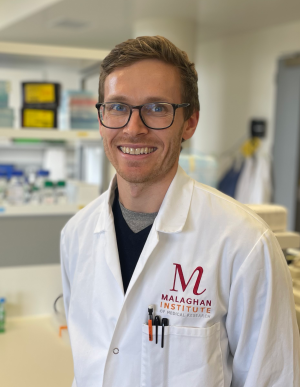
Dr Mules is a consultant gastroenterologist and research leader at the Malaghan Institute. He will spearhead groundbreaking work on “Defining Mucosa-Associated Microbial and Metabolic Mechanisms in PSC–IBD Pathogenesis.”
This innovative project aims to uncover how gut microbes and bile acids interact to drive inflammation in patients with Primary Sclerosing Cholangitis (PSC) and Inflammatory Bowel Disease (IBD). Using advanced omics technologies—metagenomics, metabolomics, and transcriptomics—the study will analyze tissue samples from PSC–IBD patients, IBD-only patients, and healthy controls.
The research is expected to:
-
Identify microbial and metabolic signatures linked to PSC–IBD.
-
Clarify mechanisms within the gut–liver axis that influence disease progression.
-
Lay the foundation for novel therapeutic strategies to improve patient care.
Past recipients include:
- 2024 Dr Simone Bayer
- 2023 Dr Chris Varghese
- 2022 Dr Safina Gadeock
- 2021 Dr Akhilesh Swaminathan
- 2020 Dr Paulo Urbano
- 2019 Dr Clarence Kerrison
- 2018 Dr Akhilesh Swaminathan
- 2017 Dr Marius van Rijisoever
- 2016 Dr Debi Prasad
- 2015 Drs Russel Walmsley, Andrew McCombie, Murray Barclay, Michael Schultz
- 2014 Drs Peter Swan, Russell Walmsley & David Orr